
Dive into getting the most out of your dxAquaria qPCR test results
You have your qPCR aquarium results – now what?
One of the critical elements to the interpretation of any test results is understanding actionable steps once results are provided.
At dxAquaria, we take the ambiguity out of how to interpret qPCR aquarium results by having an in-house trained technician review the raw results for you and provide a summary of the overall results. All results are related back to your specific water sample to tailor the results to your unique situation.
Compiled information submitted by the user about your marine aquarium system.
Technician interpretation of your sample results unique to your situation, helping guide aquarium disease monitoring decisions.
Sample data are reported per disease target as the number of copies of DNA per milliliter of the sample provided (copies/mL in aquarium pathogen testing).
Since some disease-causing organisms can exist at low levels without causing problems, “Target values” are listed as suggested initial thresholds of concern in marine fish disease testing.
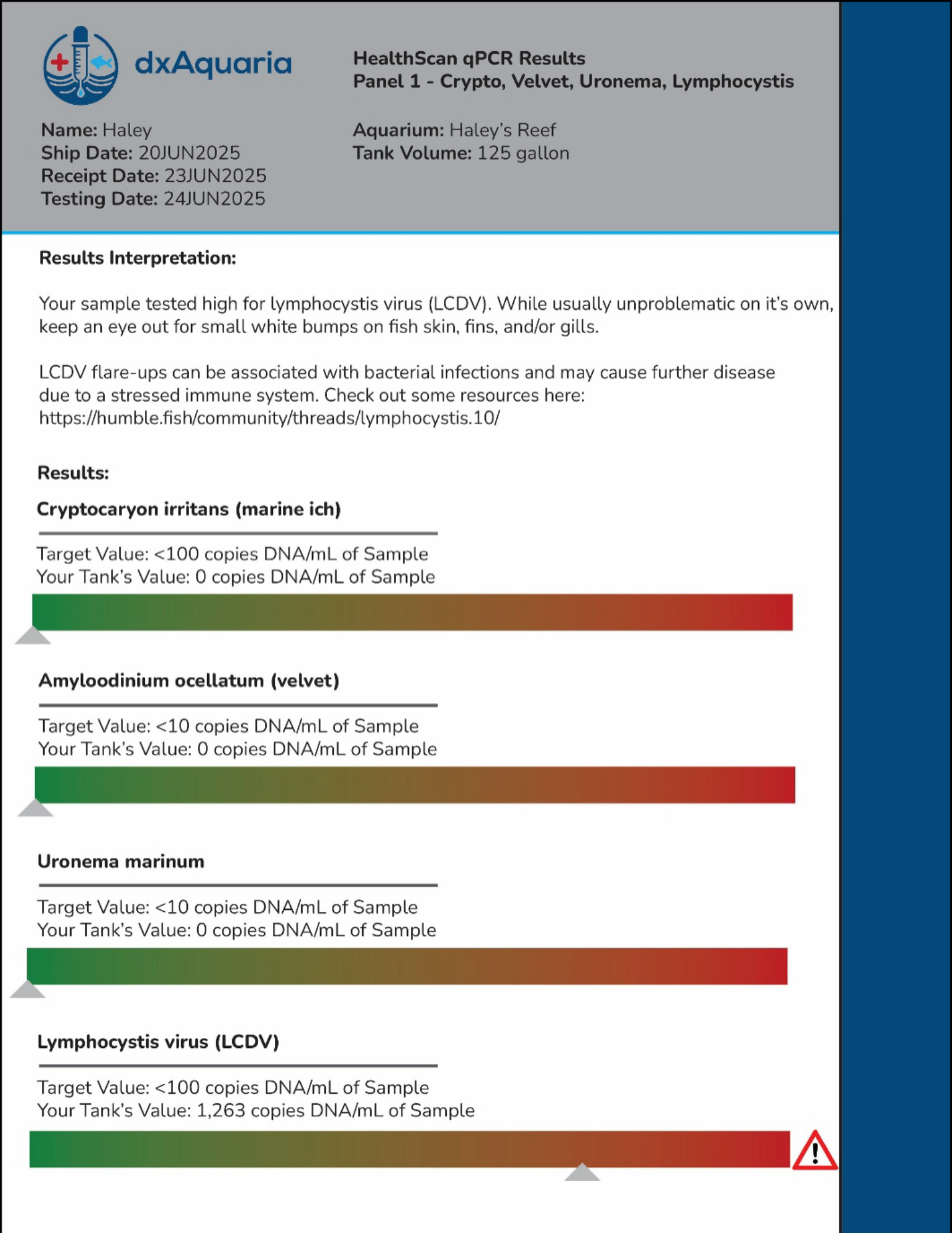
All results are compiled on your personal client portal on the dxAquaria website for access anytime. On the portal, you can find not only the concentration of microbial DNA in the sample, but also a qualitative “positive / negative” call based on general brackets per organism—helping simplify dxAquaria qPCR test results interpretation.
For example:
| Sample is… | Which means… | Concern Level | |
| If = 0… | Negative | No target DNA was found | None, undetected |
| If between 0 and 100… | Positive, Low Concentration | A small amount of DNA was found | Detected, treatment likely unnecessary |
| If between 100 and 10,000… | Positive, Moderate Concentration | A moderate amount of DNA was found | Detected, treatment and/or close observation may be necessary |
| If ≥ 10,000… | Positive, High Concentration | A large amount of DNA was found | Detected, severe illness likely and rapid treatment necessary |
Most samples exist within the “Negative” and “Positive, Low Concentration” range with concentrations between 0 and 100 copies/mL. While a result in the “Low Concentration” bracket may not indicate a need for immediate action, it can be a great sub-clinical indication of pathogen levels in aquarium systems. In other words, the bracket indicates the pathogen could be present but may not have been causing active disease at the time of sampling. As the caretaker, this can give you valuable insight into how to prevent future outbreaks with your current livestock.
For the “Moderate Concentration” and “High Concentration” brackets, these are marked as “alerts” within the portal since they may require more immediate attention depending on which pathogen was detected (such as Ich or Velvet detected via qPCR).
To better assist aquatic caretakers, we’ve partnered with the veterinarian team at AVMADS (Aquatic Veterinary Medicine and Diagnostic Services, New York, USA) led by Dr. Alex J. Hall, DVM.
Dr. Hall and the dxAquaria team have worked in tandem to provide relevant resources on disease identification, understanding, and treatment to give our clients the most comprehensive care possible.* All “Moderate” and “High” results are escalated to and reviewed by Dr. Hall and his team to allow for licensed veterinarian input on clinical significance and suggested paths forward. Between the speed of technical interpretation at dxAquaria and the veterinary expertise of AVMADS, we bring professional, relevant, and accessible knowledge to you through both the veterinary and molecular diagnostics lenses for aquarium disease monitoring.
Every system’s microbiome is a unique, complex web of life that changes over time based on an infinite number of variables. Factors such as livestock stress, feeding schedules, bio-load, and parameter stability can cause microbial concentrations to increase and decrease over time, and pathogens are no exception to these factors in marine aquarium disease monitoring.
The qPCR test is designed to be a snapshot of what is happening in the system at the time of sampling. As one single data point, the results provided can be useful in figuring out what pathogen(s) are elevated or present at that time. The value of the test for use increases as more tests are submitted. The user portal allows you to plot your specific dxAquaria qPCR test results over time by each tested pathogen to gain a better understanding of how pathogen concentrations may be changing over time. These trended results can be incredibly helpful in monitoring changes over time such as fallow or treatment periods. On top of that, multiple data points over time can assist you in figuring out what changes could have played major factors in disease levels (parameter changes, addition/removal of livestock, etc) based on the sampling date.
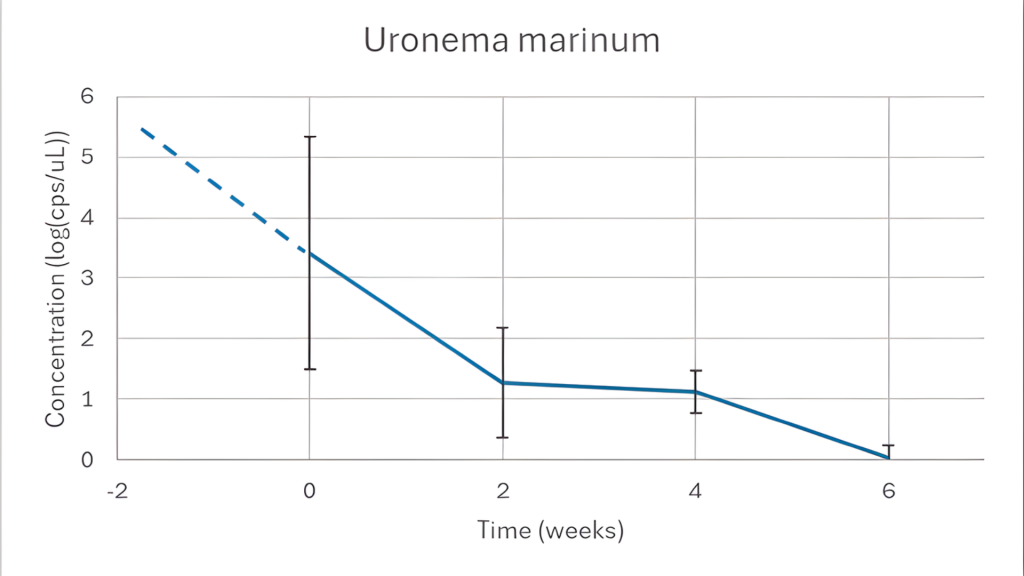
The ability to plot, monitor, and survey these data over time gets to the main purpose of these quantitative tests, and we recommend monthly testing to all clients for a better understanding of their unique system. Not only could monthly testing catch otherwise unknown changes in pathogen DNA concentrations in aquarium systems, but it can also be used as a tool for evaluating systemic stress levels and overall health. Multiple data points over time also gives dxAquaria and the AVMADS team a great opportunity to ensure the result interpretations are relevant to your situation at hand.
We take great pride in assisting aquatic caretakers through data-centric means, and we look forward to helping you to provide your aquatic animals with the best care possible.
dxAquaria’s qPCR and rapid tests are designed for the detection and quantification of microbial DNA/RNA from environmental samples for surveillance and informational purposes. These tests have not been validated or approved by the USDA or any other regulatory or veterinary governing body.
The results provided ARE NOT a clinical diagnosis of disease. They are intended to be used as a screening and monitoring tool to be interpreted by a qualified professional. All diagnostic and treatment decisions must be made in consultation with a licensed veterinarian who can assess the results in the context of clinical signs and other diagnostic evidence. dxAquaria and its partners assume no liability for actions taken or decisions made based on these test results alone.